PEX vs polybutylene comes down to a stamp on the pipe, not its color. How to identify yours, what the claim deadlines were, and what it means for resale.
- Filed under
- Plumbing & Water
- Code cited
- 24 CFR 3280.604, 3280.4
- Sources
- 2 listed
- Includes
- 2 figures
- Reading time
- 6 min

Almost everything written in English about PEX vs polybutylene was written by a company that sells repiping. That does not make it wrong, but it does mean the tone runs hot. Here is the version built from the federal standard, the court record and the pipe itself.
Start with the useful part: the color of your pipe tells you very little, and the printing on it tells you everything.
PEX vs polybutylene: read the stamp, not the color
Polybutylene is usually gray, and also comes in white, silver, black and blue. PEX comes in red, blue and white. So color overlaps and is a weak clue at best.
What does not overlap is the marking printed along the pipe:
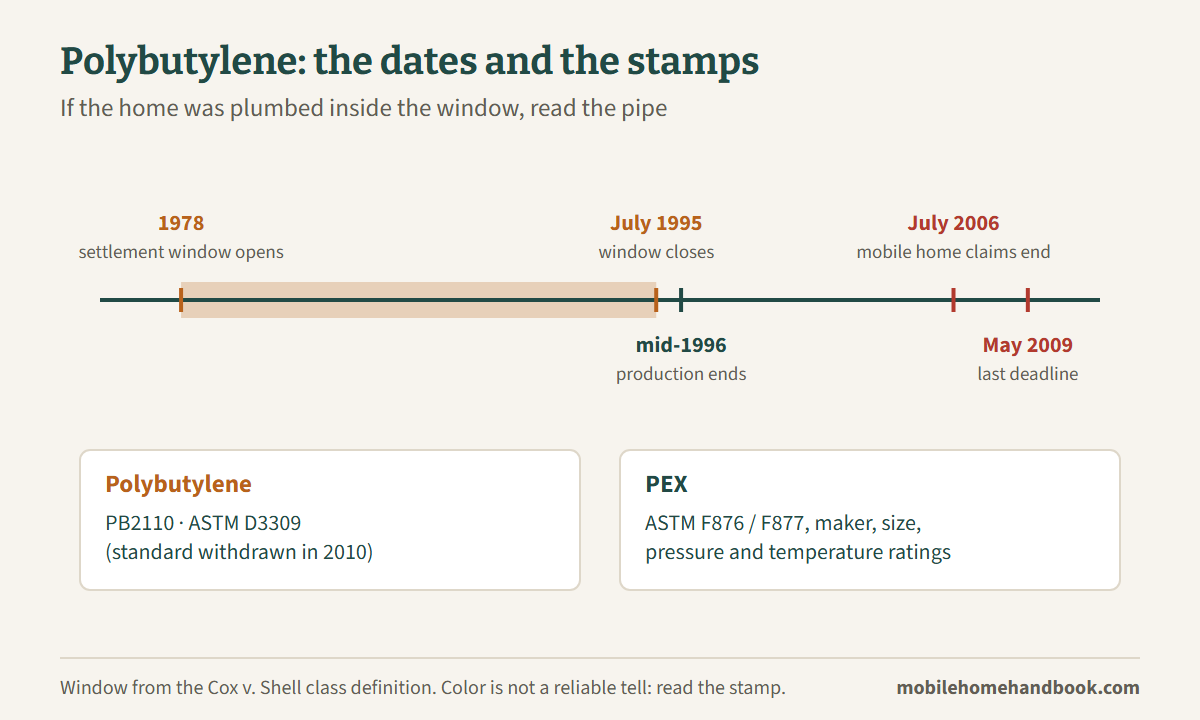
- Polybutylene is commonly stamped PB2110, and its standard designation is ASTM D3309.
- PEX prints ASTM F876 and F877, along with the manufacturer, size, and pressure and temperature ratings — typically 160 psi at 73°F, 100 psi at 180°F, 80 psi at 200°F.
The fittings back it up. Polybutylene systems used insert fittings — acetal plastic or metal — with a crimped aluminum band. PEX uses copper or brass crimp rings, or expansion fittings. If the ring on the joint is copper, you are not looking at an original polybutylene system.
Check at the water heater, the main shutoff, under sinks, and where lines enter through the skirting.
What the federal standard still says
Here is something no repipe company will tell you, and it is verifiable in two clicks.
24 CFR 3280.604 lists the plastic piping standards permitted in manufactured homes, and polybutylene to ASTM D3309 is on that list, alongside CPVC, PEX to F876 and F877, and the rest. 24 CFR 3280.4 pins the exact edition: ASTM D3309-92a, from 1992.
ASTM itself withdrew D3309 in 2010. The standard the federal code still points to has not existed as a live standard for over fifteen years. HUD’s 2024 rulemaking did clean up another withdrawn reference — it removed UL 1995 because it had been superseded — but D3309 stayed.
Two honest caveats. First, this is a paperwork artifact, not a statement that anyone is installing PB today; production ended in the mid-1990s. Second, we could not confirm whether the 2024 rulemaking considered removing it, so we are not claiming HUD refused to.
When it was installed
The cleanest source for the dates is not a plumbing company, it is the class definition in the national settlement: properties “in which there was installed between January 1, 1978, and July 31, 1995, PB Plumbing.”
Production ceased in mid-1996. If your home was built in that window, look. If it was built after, you almost certainly have PEX or CPVC.
Why polybutylene fails
The mechanism is documented in peer-reviewed work rather than marketing. A 2019 study in Polymer Degradation and Stability aged polybutylene in chlorinated water and concluded that “not only dissolved chlorine but also water pressure contribute to promoting the degradation of plastic pipes.” What happens is antioxidant depletion followed by oxidation: under pressure, less antioxidant remained and mechanical properties fell with aging time.
In plain terms, disinfectant in the water slowly eats the pipe from the inside, micro-cracks work outward, and pressure accelerates it.
One correction to the common story. Many agents and owners believe this is purely a fitting problem — that the acetal inserts failed and the pipe was fine. An experienced ASHI inspector has pushed back on exactly that: newer fittings may contribute to deterioration of the pipe, and the pipe itself can fail. Installation quality matters too; there are several ways to make a bad crimp.
The lawsuits are closed. All of them.
This matters because hope here is expensive.
The Cox v. Shell settlement, approved in a Tennessee court in 1995, put roughly $950 million toward replacing leaking PB systems and reimbursing damage, with a separate Alabama settlement adding DuPont money. It was real, and it paid.
It is also over. The claim deadlines in the official notice were staggered, and the one covering mobile homes expired on 31 July 2006. The longest deadline of all — seventeen years from installation, capped at 1 May 2009 — has also long passed. Since installation stopped in 1995, every window is shut.
If a company tells you there is still money available, check that claim carefully before you pay anyone to pursue it.
What it means for selling and insuring
Here the best source is a regulator, and its position is more measured than the internet’s.
The North Carolina Real Estate Commission’s published position is that “the mere presence of polybutylene piping in a structure is NOT a material fact.” It becomes a material fact when the licensee knows or should have known there is a probable defect. The Commission’s reasoning: not all PB with insert fittings fails, defects are not evident without investigation, and neighboring states take the same view.
The same guidance makes the practical point that matters more to a buyer: an insurance restriction can itself be material. Their advice to agents is to have buyers talk to their insurer before making an offer.
On insurance we should be straight with you. We could not find a single state department of insurance that has published a position on polybutylene. Everything circulating about carriers refusing to write PB homes comes from repipe companies and brokers. It may well be true in your state with your carrier — ask them, and get the answer in writing. Do not price a decision off a number from a blog.
What a repipe costs
Orientative figures, from a contractor marketplace rather than any public dataset: around $600 to $1,600 per fixture, with labor making up 60 to 75 percent of the bill at $45 to $150 an hour, and permits $50 to $500.
The per-fixture structure is more useful than any average, because it scales with your bathroom count rather than your square footage.
Permits, and who issues them
In a manufactured home the permit usually goes through the state housing agency, not the city. California requires a permit to install or modify the water system or the drain, waste and vent piping — a whole-home repipe is squarely inside that. Washington requires a permit for adding or replacing plumbing fixtures. Check your own state agency first.
Common questions
Do I have to replace polybutylene?
No rule requires it. The decision is about risk, insurance and resale, not compliance.
Can I replace it a section at a time?
People do, usually after a leak. It leaves the rest of the system the same age and the same chemistry.
Is gray pipe always polybutylene?
No. Read the stamp. PB also came in white, black, silver and blue, and other gray plastics exist.
My home was built in 1999. Should I worry?
Production ended in the mid-1990s, so it is unlikely. Check the stamp anyway; it takes a minute.
Sources
How we researched this: compiled from the federal HUD Code (24 CFR 3280 and 3285), listed above. Links checked October 22, 2026. This guide is research, not a site inspection, and has not been reviewed by a licensed installer or contractor.