A mobile home furnace not igniting is usually one of six things you can check yourself. Where the line is, and the reset button you must never press.
- Filed under
- Heating, Cooling & Insulation
- Code cited
- 24 CFR 3280.709, 3280.713, 3280.705 +2
- Sources
- 5 listed
- Includes
- 2 figures
- Reading time
- 7 min
A mobile home furnace not igniting is usually one of about six things, and four of them cost nothing to check. But this is a gas appliance, so before anything else, two lines that are not negotiable.
If you smell gas, leave and call from outside. And if you find a red manual reset button on the furnace, do not press it — the rest of this article explains why that one button is different from everything else here.
Why your furnace is not a house furnace
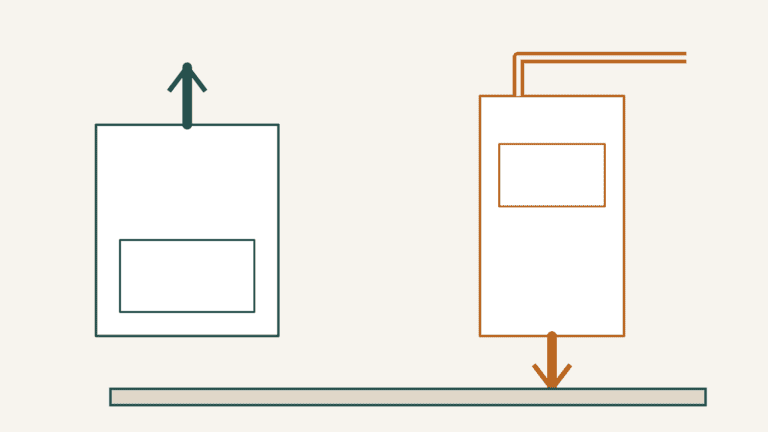
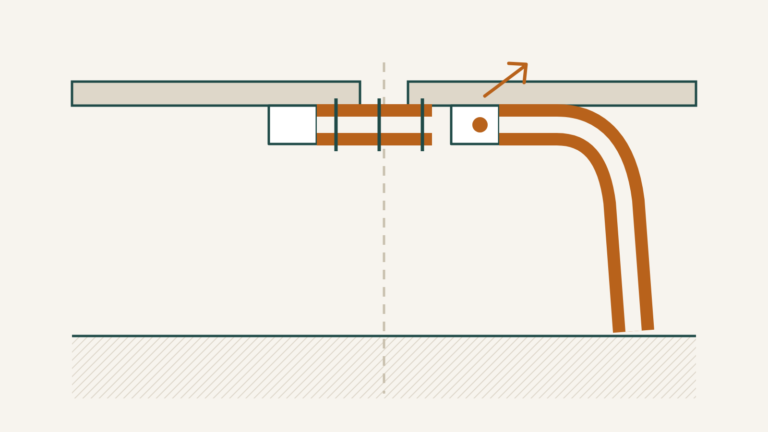
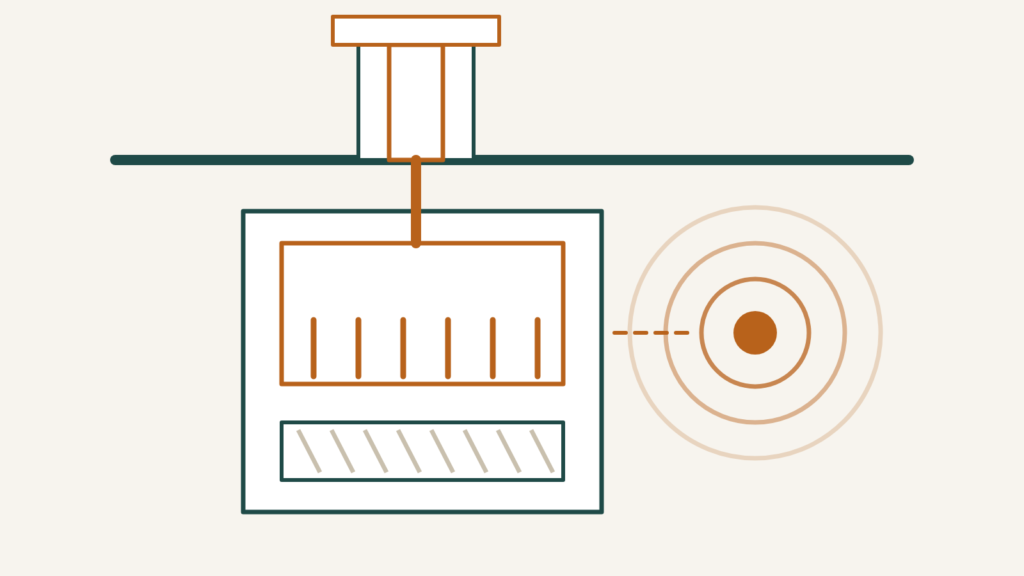
This matters for diagnosis, not trivia. 24 CFR 3280.709 requires “the complete separation of the combustion system from the interior atmosphere.” Your furnace is a sealed-combustion, downflow unit that draws combustion air from outside through one pipe and expels flue gas through another, usually one inside the other, up through the roof.
The consequence: a blockage at that roof cap kills the appliance just as surely as a gas failure, because the same fitting handles both air in and gas out. A conventional house furnace does not behave this way.
Read the light before you touch anything
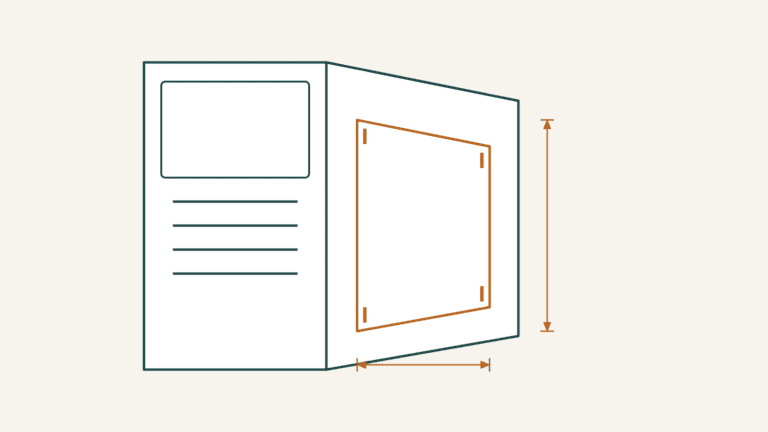
Almost every furnace made in the last thirty years has a small status LED visible through a window in the access panel, and it blinks a fault code. 24 CFR 3280.713 actually requires enough room “to enable the operator to observe the burner, control, and ignition means” — looking at it is a designed-in activity, not an intrusion.
Do not look up a generic flash-code table. This is the single most useful warning in this article. On Nordyne, Intertherm, Miller and Revolv equipment, four flashes means ignition lockout. On Coleman and Evcon equipment, four flashes means the limit switch is open. Five flashes is reversed polarity on one and a tripped rollout switch on the other. Acting on the wrong table can send you resetting an appliance that has a venting fault.
Write down two things: the number of flashes, and the brand and model from the data plate inside the door. That pair is what identifies the fault, and it is what a technician wants on the phone.
Mobile home furnace not igniting: the six checks that cost nothing
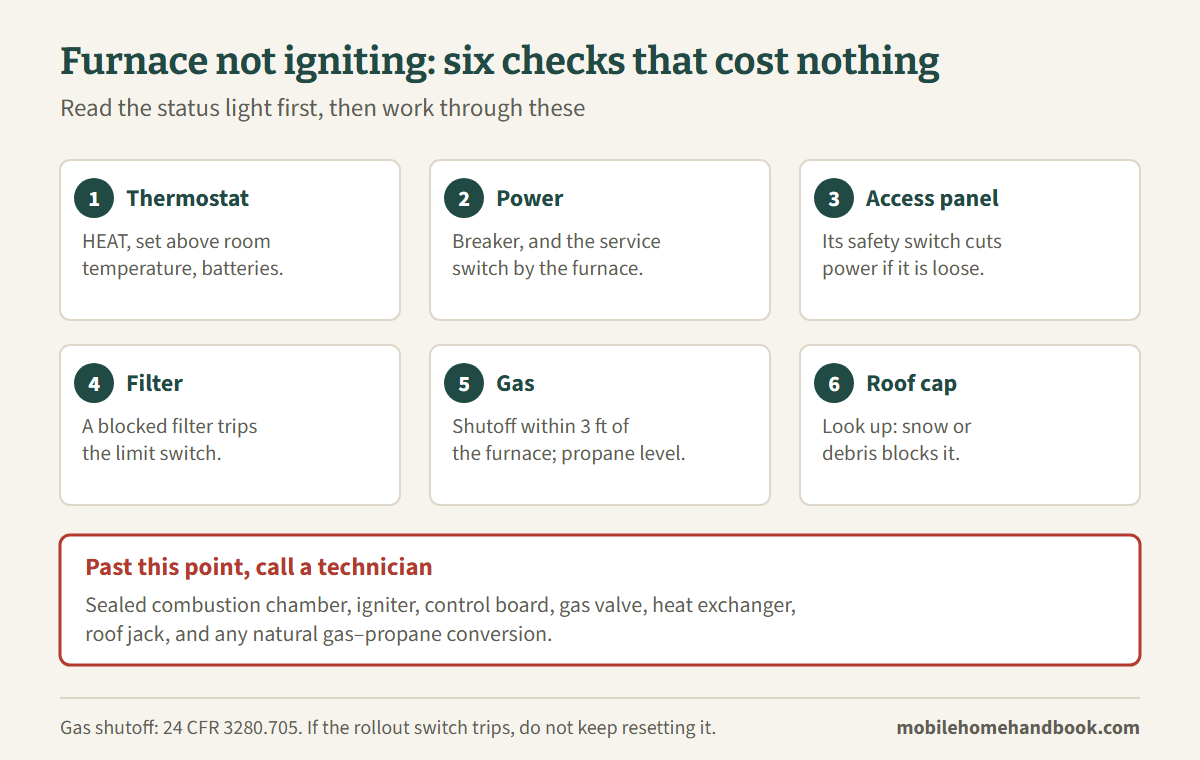
1. The thermostat. Set to HEAT, target above room temperature, and check the batteries. It is embarrassing and it is common.
2. Power. The breaker, and the service switch beside the furnace — it looks like a light switch and gets flipped by accident. If the status LED is completely dark, start here.
3. The access panel. Many of these furnaces have a spring-loaded cut-off switch on the blower panel that “will automatically de-energize the electrical power supply to the furnace when the blower access panel is removed.” A panel left half-seated after a filter change gives you a furnace with no light, no sound and no fault. On models without that switch, the hinged fire door matters even more: the manufacturer’s own warning is that leaving it open can let products of combustion into the living space.
4. The filter. A blocked filter starves airflow, the heat exchanger overheats, and the limit switch shuts the burner down. Manufacturers suggest checking every three months, and weekly for the first month in a new home.
5. Gas. The shutoff valve at the appliance — 24 CFR 3280.705 requires one within three feet of it — plus the tank valve and the tank level if you are on propane.
6. The roof cap. Look up at it from the ground. Manufacturers warn plainly that “if the roof jack crown is covered or blocked with snow, the furnace will not operate properly,” and one advises an external extension in HUD snow load zones where accumulation exceeds seven inches. Snow, ice and debris all do the same thing.
If the furnace went into lockout, the manual’s own recovery is: turn the thermostat to its lowest setting, wait a minute, then set it above room temperature and let it try again. Once. Repeating failed ignition cycles pushes unburnt gas through the heat exchanger.
The safety switches, and the one you never reset
Three interlocks can stop ignition, and they are not equivalent.
The limit switch trips on overheating and, on most of these units, resets itself automatically. A furnace that runs and then stops on its own is usually pointing here, and the cause is nearly always airflow: filter, blocked return, closed registers, or a collapsed crossover duct.
The pressure switch verifies the inducer is actually moving air before the gas valve is allowed to open. It is the direct defense against firing with a blocked vent. If it will not close, suspect the vent termination first.
The rollout switch is the one with the manual reset button, and it means flame came out of where it belongs. The manufacturer’s own instruction when it opens is to “check for proper combustion air, proper inducer operation, and primary heat exchanger failure or burner problem.” A cracked heat exchanger is on that list. Resetting it repeatedly without finding the cause is the exact path to carbon monoxide in your home. Press it once and you have learned nothing; call someone.
Why the vent cap deserves your respect
In 1987 the CPSC warned about gas furnaces in mobile homes where “failure to detect roof jack cap corrosion or other damage may lead to blockage of the vent system creating a potential carbon monoxide hazard.” In the 24 years those furnaces had been produced, it recorded 27 fatalities from carbon monoxide poisoning where roof jack damage may have been a factor.
That notice is old. The physics are not. It is the strongest argument there is for the annual inspection the CPSC still recommends for every fuel-burning heating system — and for looking up at your own roof cap once a year.
Newly built manufactured homes with a fuel-burning appliance are now required to have interconnected, hard-wired carbon monoxide alarms under 24 CFR 3280.211. That rule governs construction, so it does not reach back to a home built in 1998 — which is a reason to fit one yourself, not a reason to skip it.
Where the line is
Everything above is owner territory. Past it is not: the sealed combustion chamber, the hot surface igniter and control board, the gas valve, the heat exchanger, the roof jack itself, and any conversion between natural gas and propane, which 24 CFR 3285.904 requires “a service person acceptable to the LAHJ” to perform.
One thing you should never do regardless of age: light an automatic-ignition furnace by hand. The manuals say it outright — “Do not attempt to light this furnace by hand (with a match or any other means).”
What it costs
Orientative figures from cost aggregators, not from any government or manufacturer source: furnace repairs average $125 to $480, with an igniter replaced for $100 to $250 installed. A replacement manufactured home furnace runs $1,200 to $3,700 installed depending on fuel.
The gap between those two numbers is the argument for reading the LED before you assume the worst. An igniter is a consumable — they last roughly three to seven years — and it is a fraction of the price of the appliance.
Common questions
The blower runs but there is no heat.
That is usually not an ignition fault at all. Check the crossover duct under a double-wide, and the filter.
Can I replace the igniter myself?
It is inside the sealed combustion area, which is precisely the boundary the federal standard draws. This is not a DIY part.
How often should it be serviced?
The CPSC recommends a yearly professional inspection of every fuel-burning heating system, and manufacturers list the same at the start of each heating season.
Can I put a regular furnace in instead?
No — and that is its own conversation, because the reasons are structural as well as legal.
Sources
- 24 CFR 3280.709 — Installation of appliances (eCFR)
- 24 CFR 3280.713 — Accessibility (eCFR)
- 24 CFR 3280.705 — Gas piping systems (eCFR)
- 24 CFR 3280.211 — Carbon monoxide alarm requirements (eCFR)
- 24 CFR 3285.904 — Utility system connections (eCFR)
How we researched this: compiled from the federal HUD Code (24 CFR 3280 and 3285), listed above. Links checked October 22, 2026. This guide is research, not a site inspection, and has not been reviewed by a licensed installer or contractor.